 Onsen Hopper
What is an onsen?
Under Japan's Onsen Act, enacted in 1948, an onsen is warm water, mineral water, steam or other gas (natural gas that is mainly hydrocarbons excluded) that wells up from underground and has a temperature or a substance listed in the Act's table.
Written by Max, checked 2026-10-21
- 1,397 of 1,475 listed onsen state a day-use price
- ¥750 median day-use price across the 1,397 that state one
- 32 listed onsen charge nothing for day use
Our database, checked 2026-10-30.
What is an onsen?
Under Japan's Onsen Act, enacted in 1948, an onsen is warm water, mineral water, steam or other gas (natural gas that is mainly hydrocarbons excluded) that wells up from underground and has a temperature or a substance listed in the Act's table. In everyday speech 'going to an onsen' means visiting a place that uses that water for bathing, which the Act calls a hot spring-use facility.
The Act's own wording, in Article 2, is warm water, mineral water, steam and other gases from underground, excluding natural gas that is mainly hydrocarbons, with a temperature or a substance listed in its appended table. JNTO's shorthand covers both senses: hot springs and the bathing facilities built around them are called onsen in Japanese. Heated geothermally, onsen are found across Japan.
Onsen Hopper lists 1,475 baths that take day visitors; 1,397 state a day-use price, the median day-use price is ¥750 and 32 are free, checked 2026-10-30. See the onsen list or the map.
How hot does an onsen have to be?
25 degrees Celsius or more, measured when the water is taken from the spring source. Water below 25 degrees still counts as an onsen if it meets even one of the substance conditions.
The substance test is met by containing any one of the substances in the Act's table at or above the amount per kilogram that the table sets. Onsen facilities post details such as the source name, spring quality and temperature where bathers can easily see them. Read that sheet before you get in.
What kinds of onsen water are there?
A simple spring has under 1,000 milligrams of dissolved substances, not counting gases, per kilogram of water and a temperature of 25 degrees or more. A saline spring has 1,000 milligrams or more of dissolved substances, not counting gases, per kilogram.
Springs that contain a particular substance at or above its set limit include sulfur springs, carbon dioxide springs and radioactive springs. JNTO puts it simply: the texture and mineral content of onsen water vary by region, so each onsen's water is distinct. Besides a full soak there are footbaths, mud baths and sand baths.
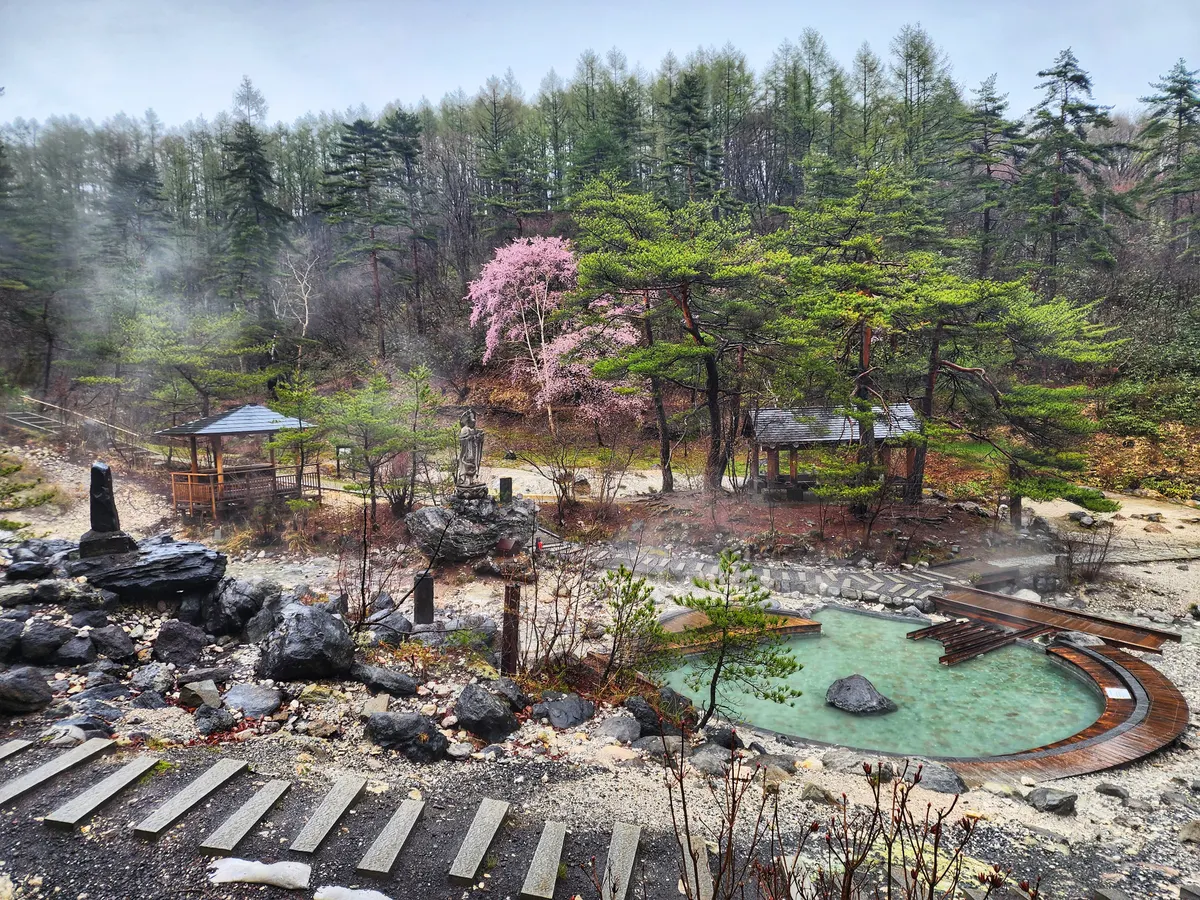
Many onsen offer a view, and some are open-air baths, called rotenburo. Some rotenburo have views of mountains or overlook streams. Otakinoyu in Kusatsu describes its own baths as 100% natural free-flowing water. Gozanoyu, also in Kusatsu, says its two baths are constantly filled from two springs.
How many onsen are there in Japan?
JNTO, citing 2015 Ministry of the Environment data, puts it at about 27,000 hot spring sources, some 9,500 of them, about 35 percent, in Kyushu. That figure counts spring sources, not places to bathe.
Onsen Hopper lists 1,475 bathhouses, inns and outdoor baths that take day visitors, 32 of them free to enter, checked 2026-10-30. The well-known towns are collected on famous onsen.
Who regulates onsen?
Using an onsen for public bathing or drinking needs permission from the prefectural governor, or in some cities from the mayor or ward head. A facility with that permit must post the spring's components and other details.
The temperature and substance test itself comes from the Onsen Act, enacted in 1948. How a sento differs is on onsen vs sento. Paying to bathe without staying the night is on how day use works.
Questions
What does the word onsen mean?
In the Onsen Act it is the water itself: warm water, mineral water, steam or gas (other than hydrocarbon natural gas) from underground that meets the temperature or substance test. In daily conversation it is the place you bathe, which the Act calls a hot spring-use facility.
Can an onsen be cold?
Yes: water below 25 degrees is still an onsen if it meets even one of the substance conditions. The 25 degree rule is measured at the spring source.
Is every onsen the same water?
No: JNTO says the texture and mineral content of onsen water vary by region, so each onsen's water is distinct. A simple spring has under 1,000 milligrams of dissolved substances, not counting gases, per kilogram and is 25 degrees or more. A saline spring has 1,000 milligrams or more.
Sources
- Ministry of the Environment, 温泉の定義 [温泉の保護と利用], checked 2026-10-21
- Aomori Prefecture, 温泉の種類と効能, checked 2026-10-21
- e-Gov Law Search (Japan), 温泉法, checked 2026-10-21
- Japan National Tourism Organization, Hot springs in Japan | Travel Japan (Japan National Tourism Organization), checked 2026-10-21
- Japan National Tourism Organization, How to Best Enjoy Japan’s Onsen, checked 2026-10-21
- Tokyo Metropolitan Government, 温泉の利用について, checked 2026-10-21
- Japan National Tourism Organization, ONSEN, checked 2026-10-21
- Japan National Tourism Organization, Enjoy Bath Culture in Japan | Blog | Travel Japan (Japan National Tourism Organization), checked 2026-10-21
- Kusatsu Tourism Public Corporation, Otakinoyu, Kusatsu Onsen, checked 2026-10-21
- Kusatsu Tourism Public Corporation, Gozanoyu, Kusatsu Onsen, checked 2026-10-21
- Ministry of the Environment, 温泉法の概要 [温泉の保護と利用], checked 2026-10-21
Made by Max for Onsen Hopper · Where the facts come from